
The
picture I have chosen is entitled Bathers at La Grenouillère and it was
painted by Claude-Oscar Monet in 1869. It is an oil on canvas. The scene
represented occures during a sunny evening and shows lower-class people. In the
center of the picture, some of them are walking on a narrow wooden walkway. In
the background, the others are swimming in the Seine. In the foreground, there
are little wooden ships which are standing next to the walkway. We can suppose
that Money painted this work, like Renoir, in front of the café.
Actually,
there are many colours share out all over the picture and like « touch
lights ». Besides, it shows the lower-class’s ascent in the society during
the 19th century. That is the reason why I advice everybody to have a look at it.
 |
| Bathers at La Grenouillère, Monet |
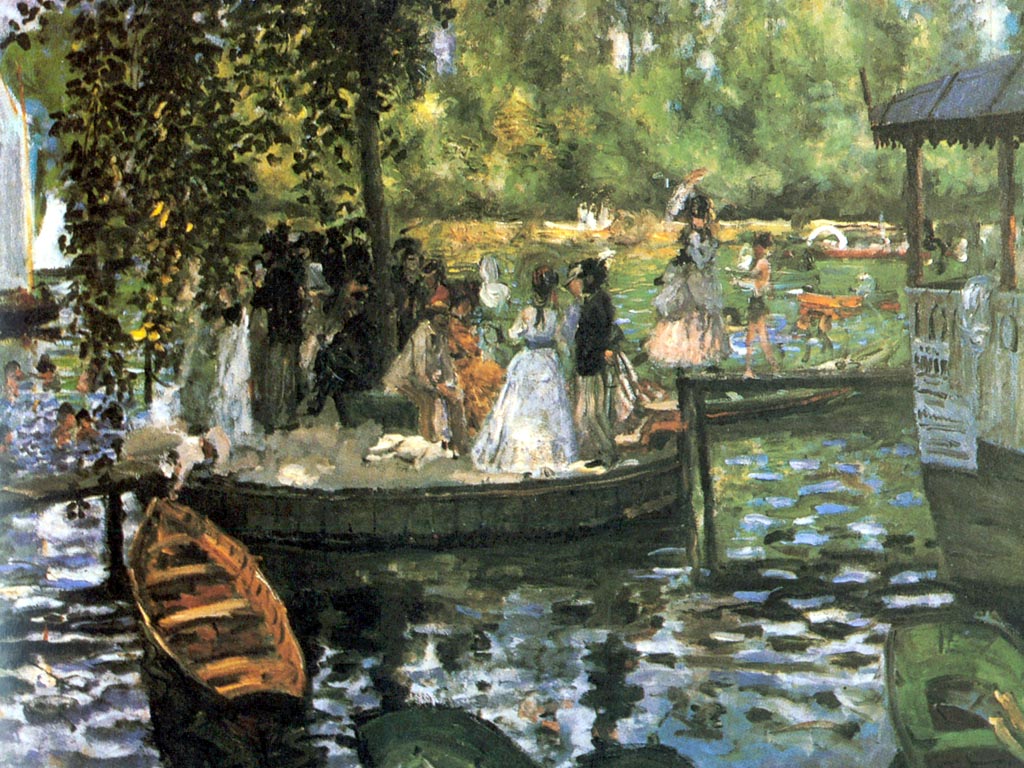
I have chosen this work because it reminds me of a work that we have made in french class at the beginning of the school year when we studied the widespread artistic movement of the 19th century which was impressionism. This work is entitled La Grenouillère and it was painted by Renoir. Actually, this masterpiece is very close to Monet's one but it's very interesting to see their different points of view, their different way of paint and their different way to see the event.
 |
| La Grenouillère, Renoir |
*~*~*~*
 |
| The Water-Lily Pond, Monet |
I chose The
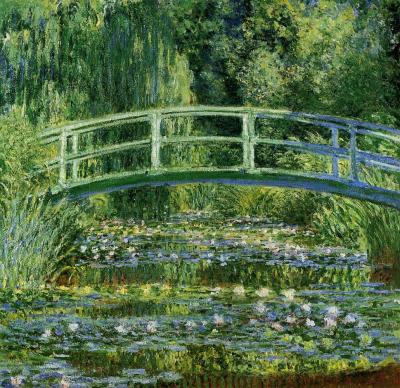
Water-Lily Pond, painted by Claude-Oscar Monet in 1899. This
painting represents a bridge striding over a lovely pond. In fact,
Monet has painted this body of work in his French garden of Giverny.
It kept my attention because of its beautiful light colours.
Furthermore, it makes me feel quiet by evocating the countryside,
with water noise and wind in the vegetation. Moreover, the
impressionist techniques give back with poetry and faithfulness what
the painter saw, including water reflects. It's a very luminous and
apaising painting, and that's what I would say to my friends to
convince them. Besides, Monet has represented this
japanese-inspirated bridge more than fifteen times, permitting to
evaluate its changes according to the time and to Monet's cataract.
This eyes disease affected his vision and his colours perception.
Gradually, he became just able to see warm colours, such as red,
orange, yellow, or dark green. Fortunately, he had an operation and
regained a normal sight.

Aucun commentaire:
Enregistrer un commentaire