vendredi 17 mai 2013

Museum of London - Docklands


   Slavery means abusing of other populations to make them work without paying them. European nations developed a well-organized mechanism for supplying plantations with abudant labour. Slaves might have felt humiliated physically and mentally by brutal owners. They lost their own identity (replaced by "slaves" names), family members were separated, those speaking the same language were sent to different plantations. Moreover, permanent relationships between men and women were discouraged, and any signs of their culture was forbidden.

   Firstly, Africans resisted enslavement in different ways, from sabotage to armed uprising. Then Haitians, who broke out in the French colony of Saint Domingue, under the leadership of Toussaint L'Ouverture. Abolitionnists fought in Europe by petitionning or speaking tours. Women also played a leading role radicalizing the movement, particularly by creating a network of societies which made pressure on the esclavagist. African writers such as Ottobah Cugogno, Olaudah Equiano or Ignatius Sanch played a crucial role, as well as the writing of the Declaration of Rights of Men and Citizens.

   Nowadays, slavery still exists. Children are particularly abused in some countries such as Haïti, where they must serve families and are called "restavecs". So even if progresses have been made, the fight against slavery must go on.

British Museum


What we preferred at the British Museum was the Rosetta Stone. Firstly because it was stricking to see this famous stone in real. Moreover, because it's a very important part of the history. Indeed, the Rosetta Stone bears an inscription in different languages, which permitted to decode the hieroglyphs.

 
In fact, it's the only surviving fragment of a longer stela, recording a decree dated of March 27th in 196 BC. At the top, the decree is written in hieroglyphs, which was the traditional script on Egyptian monuments. In the middle, the text is written in Demotic (the everyday script of literate Egyptians). And finally, the botton is written in Greek, the language used by the government. The stone was placed in a temple, probably at the city of Sais, near Rachid.

It have been discovered in mid July 1799 by soldiers in Napoleon's invading army, at the town of Rashid. The scholars immediately realised that it might help to decipher hieroglyphs, since the Greek inscription which could be read. In England and in France, two men worked on the decoding : Thomas Young (1773-1829) and Jean-François Champollion (1790-1732). Young used the cartouches on the Rosetta Stone to find the name of the Greek royal name Ptolemy, but he thought most hieroglyphs were symbolic images.

On September 14th in 1822, Champollion realised that he could read the name of earlier native Egyptians pharaohs, and that hieroglyphs were signs that must write the ancient Egyptian language. With his knowledge of Coptic language, he could start to read hieroglyphic texts.


Science Museum


- Prehistoric Medicine -

Firstly, the medicine appeared in Mesopotamia, cradle of humanity. There, the physicians thought that illnesss was caused by the invasion of an offended god or a bad spirit into the body of the patient. Healers were priests. The different methods to heal were exorcism "reading" the flight of a flock of birds or in entrails. Moreover, their surgery was very simple : just lancing or scarification.
However, Egyptian medicine was more advanced. They knew a huge number of drugs, which were principally derived from plants, but animal and mineral substances were also used. The cosmetic products were used in medicine, for instance the khol. Egyptians were the first to employ the three laxatives that are still used nowadays : colocynth, senna and castor oil. Surgery was minor.
A lot of gods were relative to medicine, such as Thoth who was the patron of physicians or Theoris, the goddess of pregnant women. Besides, Egyptians believed in afterlife : that's why they practiced mummification to preserve the corpses. Internal organs were removed, except the heart, which was considered as the seat of mind and emotions. Then, the corpse was treated and wrapped with stripes. So we can deduce that they had a great knowledge of human anatomy.


- Medicine of the Arab World -

First of all, medicine of the Arab world includes Arab, Persian, Jewish and Christian physicians working within the Islamic world. Arab medicine was derived from Greek and Roman ones. There were several famous doctors, such as Ibn-Sina or Al-Zahwari.
In this medicine, the use of drugs was extended by the introduction of mixtures. On top of that, Muslim law forbade dissection. Some of the Muslims' knowledge of anatomy was derived from clinical observation, but most was taken from Greek authorities. Many Greek therapeutic techniques were still used, but adapted and improved. Not only have Islamic physicians extended the range of ingredients used in medicine, but also they created the polypharmacy, which consisted in putting several drugs together. Islamic treatises on pharmacy and toxicology continued to exert considerable influence beyond the end of Middle Ages.

- Exploring Space Gallery -


The space exploration began by sky watching, a human activity since the beginning of humanity. But it has mostly expanded during the Cold War, when USA and Russia fought to be the first in space conquest.
The American space programm began in 1946 by the taking of the first photograph of the Earth from space. From 1962, the NASA was enable to convert missiles into space rockets. The numerous missiles projects started by the USA during the 60's have permitted to improve the aerospatial science. Then, for over three years, Russia had been beating USA in the space race : first artificial satellite (Sputnik), first animal in orbit (the dog Laïka), first Moon probe (Luna 2). Finally, in 1961, Russia sent the first man in space : Yuri Gagarin, who became a national hero.
However, it was the USA which launched the first man on the Moon in 1969, with the Apollo XI mission. That's how Neil Armstrong, accompanied by Michael Collins, became the first man to walk on our satellite – while Buzz Aldrin stayed in orbit around it. This event has been broadcasted in the whole world, by all the medias, and is a major turning point in the history of humanity. Since this date, space exploration continues, with a lot of discovers every year. And we don't know how far we can go...

National Gallery

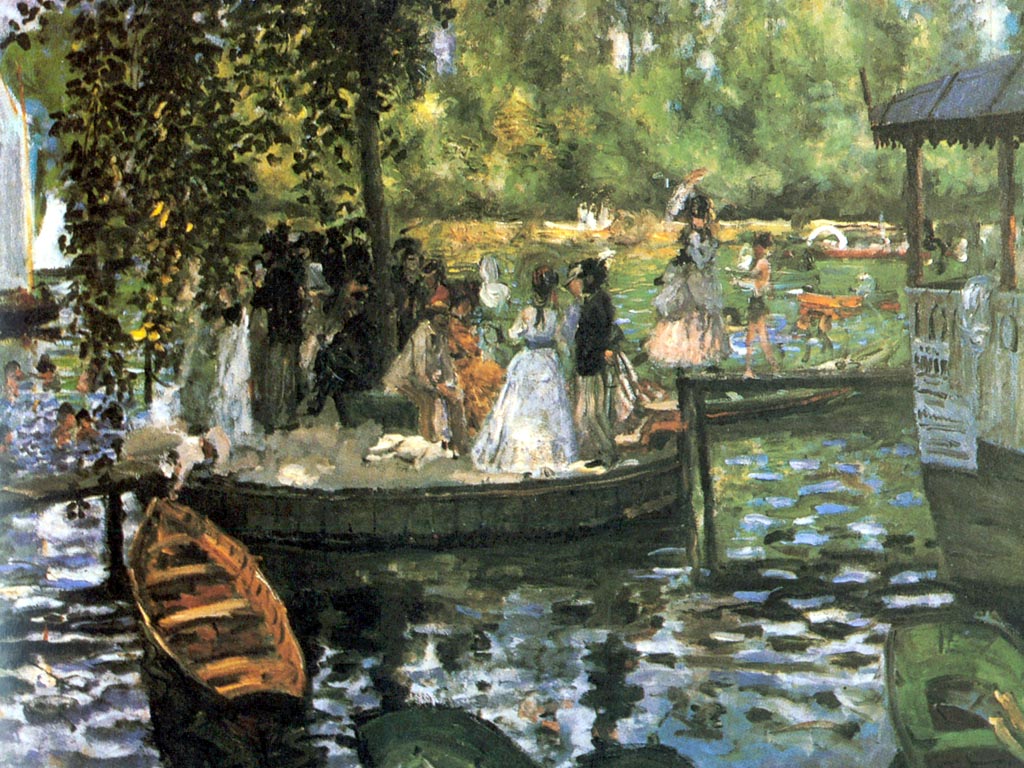
The picture I have chosen is entitled Bathers at La Grenouillère and it was painted by Claude-Oscar Monet in 1869. It is an oil on canvas. The scene represented occures during a sunny evening and shows lower-class people. In the center of the picture, some of them are walking on a narrow wooden walkway. In the background, the others are swimming in the Seine. In the foreground, there are little wooden ships which are standing next to the walkway. We can suppose that Money painted this work, like Renoir, in front of the café.
Actually, there are many colours share out all over the picture and like « touch lights ». Besides, it shows the lower-class’s ascent in the society during the 19th century. That is the reason why I advice everybody to have a look at it.

Bathers at La Grenouillère, Monet

I have chosen this work because it reminds me of a work that we have made in french class at the beginning of the school year when we studied the widespread artistic movement of the 19th century which was impressionism. This work is entitled La Grenouillère and it was painted by Renoir. Actually, this masterpiece is very close to Monet's one but it's very interesting to see their different points of view, their different way of paint and their different way to see the event.


La Grenouillère, Renoir


*~*~*~*

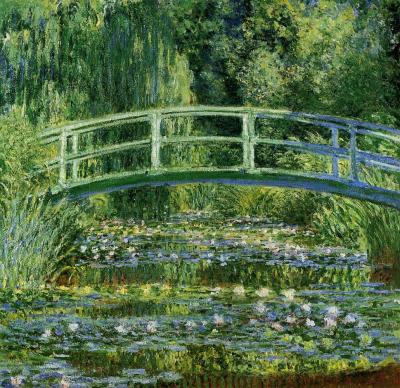
The Water-Lily Pond, Monet
  I chose The Water-Lily Pond, painted by Claude-Oscar Monet in 1899. This painting represents a bridge striding over a lovely pond. In fact, Monet has painted this body of work in his French garden of Giverny. It kept my attention because of its beautiful light colours. Furthermore, it makes me feel quiet by evocating the countryside, with water noise and wind in the vegetation. Moreover, the impressionist techniques give back with poetry and faithfulness what the painter saw, including water reflects. It's a very luminous and apaising painting, and that's what I would say to my friends to convince them. Besides, Monet has represented this japanese-inspirated bridge more than fifteen times, permitting to evaluate its changes according to the time and to Monet's cataract. This eyes disease affected his vision and his colours perception. Gradually, he became just able to see warm colours, such as red, orange, yellow, or dark green. Fortunately, he had an operation and regained a normal sight.